


Local SEO Technical Checklist 2026: 15 Fixes That Instantly Improve Google Maps Rankings
Target audience: local business owners, in-house marketers, and SEO professionals learning practical technical tactics to rank in Google Maps / Local Pack (and get more leads).
Google Maps local pack rankings are driven by a combination of your Google Business Profile (GBP) signals, on-site technical health, content relevance, reputation (reviews), and local authority. In 2026 the rules are the same pillars — Relevance, Distance, Prominence — but they’ve been sharpened by AI overviews, authenticity signals, and user-behavior data. Below is a deep, tactical, expert-level, 15-point technical checklist you can implement now to move the needle for Google Maps rankings and local lead generation. Every item includes the why, how-to, and measurement so you can act like an SEO pro. Google Help+2Backlinko+2
Quick snapshot: what matters most (short)
- GBP completeness & signals (categories, attributes, photos, services) — foundation. Google Help
- Reviews & review signals (velocity, recency, response) — trust & social proof. Advice Local
- On-site local relevance (NAP, schema, landing pages, local content) — helps Google match queries. Backlinko
- Technical performance (mobile speed, crawlability) — UX & ranking input. Backlinko
- Citations & backlinks — local prominence and authority. Advice Local
The 15-Fix Technical Checklist (deep, actionable)
1) Lock down a single canonical NAP and make it exact everywhere
Why: Google matches business name, address, and phone number (NAP) across the web. Inconsistent NAP = confusion and ranking leakage. Google Help
How-to:
- Choose one canonical representation (exact punctuation & abbreviations).
- Update it in GBP, website header/footer, schema, footer HTML, and every citation (Yelp, Bing, Apple Maps, industry directories).
- For phone numbers use a single primary number and format (E.164 is fine for technical consistency + local readable format).
Measure: Use a citation-audit spreadsheet (source URL, current NAP, status) and a tool (BrightLocal / Moz Local) to find inconsistencies. Fix until no mismatches remain.
2) Fully complete and optimize your Google Business Profile
Why: GBP signals are the heaviest single factor for Maps pack visibility; complete profiles rank better. Google explicitly recommends completeness. Google Help
How-to (advanced):
- Primary category: choose the most specific category that fits. Add relevant secondary categories (don’t stuff).
- Services & products: add structured services, prices (if appropriate), and SKUs where possible.
- Attributes: add every relevant attribute (women-owned, wheelchair access, appointment required, outdoor seating, etc.).
- Business description: 750 chars — write a keyword-rich, natural description that explains services & locations. Avoid keyword stuffing.
- Hours & special hours: maintain exact holiday/temporary hours; use the specialHours API or GBP interface for releases.
Measure: GBP completeness meter (in-dashboard), map pack impressions and queries in GBP Insights.
3) Use exact structured data (LocalBusiness schema) on landing pages & homepage
Why: Schema provides direct signals about your business’s physical presence, services, opening hours, priceRange, geo-coordinates — used in Maps & AI overviews. Backlinko
How-to (technical):
- Implement LocalBusiness or a subtype (Dentist, Plumber, Restaurant) using JSON-LD in the <head>. Include name, address (structured postalAddress), telephone, geo (latitude/longitude), openingHoursSpecification, image, url, sameAs (social links).
- For multiple locations, use distinct landing pages with location-specific schema and include @id canonical URLs.
Measure: Use Google’s Rich Results Test and Schema.org validator to ensure no critical warnings. Track indexation.
4) Add location landing pages with unique local intent content
Why: Google maps & local pack often surface businesses that match the user’s exact locality query; local landing pages increase relevance. Backlinko
How-to:
- One page per physical location (or service area cluster). Each must have unique content (no near-duplicate). Include: address, service hours, a short paragraph describing the neighborhood, local FAQs, a Google Map embed, schema, staff photos, and testimonials from local customers.
- Avoid thin “location” pages that only swap city names. Add localized images, case studies, and locally-targeted keywords (long-tail).
Measure: Organic & Maps impressions for location-specific queries. Watch for cannibalization across locations.
5) Ensure GBP and website points to the same verified address / coords (proximity integrity)
Why: Distance/proximity is fundamental. If your GBP pin or web schema coordinates differ, Maps confidence drops. owdt.com
How-to:
- On GBP confirm pin placement (move the marker to the building entrance).
- Use exact geo coordinates in schema matching the GBP pin.
Measure: Test queries using incognito and geolocation emulators; verify consistent results.
6) Fix site technical SEO: mobile-first, fast TTFB, Core Web Vitals
Why: Page experience influences local rankings and how Google chooses result snippets/answers. Slow pages = lower conversion. Backlinko
How-to:
- Mobile-first design (responsive).
- Aim LCP <2.5s, CLS <0.1, FID/INP acceptable per Core Web Vitals.
- Serve static markup for location pages; avoid heavy JS render for initial content. Use pre-rendered HTML for essential content and schema.
Measure: PageSpeed Insights / Lighthouse scores; track in Search Console; monitor on real mobile devices.
7) Optimize internal linking & local signals: “near me” anchors & local nav
Why: Internal linking helps distribute authority to location pages and signals topical relevance to Google.
How-to:
- Add a local nav (Locations > City pages) and link from service pages to location pages with contextual anchor text (e.g., “plumber in [Neighborhood]”).
- Create a single “Locations” sitemap and submit to Google Search Console.
Measure: Crawl depth, internal link counts per location page, organic visibility improvement per page.
8) Monitor and amplify review signals (quantity, recency, sentiment)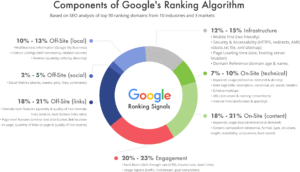
Why: Reviews are a top Maps ranking factor (impacting trust & click-through). Google and other platforms use review signals heavily. Advice Local
How-to (ethical + safe):
- Ask for reviews at the point of delight (receipt, follow-up email, SMS) with direct GBP review link. Don’t incentivize or fabricate.
- Respond to every review within 48–72 hours (thank positives, resolve negatives with contact info). Responses increase engagement signals.
- Add review snippets on site (manual excerpts, with schema review where appropriate), but do not publish full review feeds without permission.
Measure: Review count growth rate, average rating, review velocity, and conversion uplift from GBP.
9) Leverage Google Posts, Q&A, and product/service listings consistently
Why: Active GBP profiles (regular posts, answered Q&A, product lists) show freshness and engagement; Google rewards active management. Google Help
How-to:
- Schedule weekly posts for offers, events, or educational micro-content. Use UTMs.
- Proactively seed Q&A with common questions (post them, then answer as the business).
- Use product/service attributes (menus, service lists) to capture queries.
Measure: GBP engagement metrics: clicks, calls, direction requests from Insights.
10) Build clean, relevant local citations (quality > quantity)
Why: Citations still contribute to local prominence; consistency and quality matter more than raw count. Advice Local
How-to:
- Prioritize high-authority local directories, industry-specific sites, chamber of commerce, and data aggregators (Localeze, Factual if relevant).
- Ensure NAP exactness. Consolidate duplicates (claim and merge listings).
Measure: Citation score from local SEO tools and changes in local visibility.
11) Use location-specific schema for FAQs, BreadcrumbList, and Service markup
Why: Structured FAQ/schema can provide rich snippets for queries and feed AI overviews — increasing your chance to be the authoritative local answer. Backlinko
How-to:
- Add FAQPage markup for frequently asked local questions (e.g., “Do you provide same-day service in [city]?”).
- Use Service schema on service pages with areaServed and provider children.
Measure: Rich result impressions in Search Console and organic CTR lift.
12) Track and optimize behavioral signals (click-to-call, direction clicks, dwell time)
Why: Behavioral data (how users interact with your GBP & site) helps Google identify useful local results — engagement can lift rank. Advice Local
How-to:
- Use clear CTAs on GBP and landing pages: “Call”, “Book”, “Get Directions”. Use click-to-call buttons with tel: links.
- Reduce friction: one-click contact forms, prefilled SMS links, online booking widgets (where applicable).
Measure: GBP Insights (calls, direction requests), analytics on click-through from GBP to site and bounce/dwell metrics on landing pages.
13) Get local backlinks and hyperlocal content signals
Why: Backlinks from local sites (press, local bloggers, chambers, partnerships) are a strong prominence signal for local queries. Advice Local
How-to:
- Create “community” content: local event sponsorship page, neighborhood case studies, charity partnerships.
- Reach out to local news, blogs, and trade organizations for citations that include a link and NAP.
Measure: Number and quality of local referring domains, referral traffic, and improvement in local pack presence.
14) Protect GBP from spam & incorrect edits — monitor and respond quickly
Why: Competitor spam, wrong edits, or duplicate listings can damage rankings. Google’s open editing model sometimes introduces harmful changes. Google Help
How-to:
- Use GBP owners’ dashboard alerts and email forwarding to ensure you see edit notifications.
- Immediately dispute wrong edits and file verification challenges or support requests when necessary.
- Periodically check for duplicates and request merges/removals.
Measure: Frequency of incorrect edits and time-to-resolution.
15) Track, test, and iterate — build a local SEO dashboard & test plan
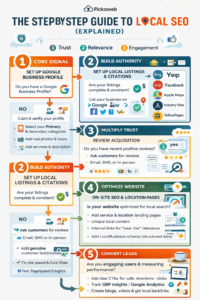
Why: Local SEO gains are iterative; what works in one market may not in another. Data-driven testing accelerates results. Backlinko
How-to:
- Create a dashboard (Data Studio / Looker Studio) combining: GBP insights (impressions/queries), Search Console, GSC queries for location pages, call tracking, review growth, ranking for target local keywords.
- Run A/B tests: different GBP descriptions, primary categories, or landing page layouts across different locations, and measure lead volume changes.
Measure: Leads per location, maps-pack rank changes, conversion rate, and ROI from local SEO efforts.
Quick wins you can do in one afternoon
- Confirm GBP pin coordinates match your schema geo.
- Ensure your NAP is EXACT across site footer, GBP, and major directories.
- Add 3 recent photos to GBP and respond to the latest review.
- Publish a short local landing page with a unique neighborhood paragraph + schema.
- Run PageSpeed on your location page and fix one Core Web Vital issue.
Common pitfalls and how to avoid them
- Stuffing categories or description with keywords: Google can penalize trickery; be accurate, not spammy. Google Help
- Duplicate location pages with minimal differences: Creates index bloat and reduces authority—merge or strengthen unique content.
- Buying fake reviews: Risky; leads to suspensions and reputation damage — never do it.
- Heavy JS-only rendering for GBP-driven content: Pre-render critical content server-side so Googlebot & mobile users see it quickly.
Measurement plan (what to watch weekly & monthly)
Weekly: GBP Insights (calls, directions, searches), review volume & responses, location page health (errors).
Monthly: Local pack rankings for primary keywords, citations audit, backlink growth, Core Web Vitals.
Quarterly: Conversion attribution (leads from Maps → closed deals), test results, and competitor move analysis.
FAQ — practical questions SEO teams ask
Q: Should I include keywords in my GBP business title?
A: Only if it’s actually part of your legal / trading name. Keyword-stuffing in titles is a known risk and can trigger manual actions. Instead optimize categories, services, and description. Google Help
Q: How many reviews do I need to rank?
A: There’s no magic number—velocity, recency, and average rating matter. Focus on steady, authentic reviews and replying to them quickly. Local competitors with many recent positive reviews will outcompete low-review profiles. Advice Local
Q: Do service-area businesses need physical addresses?
A: Service-area businesses can hide their address in GBP and still rank, but strategy differs: build strong service-area landing pages and local citations for each area you serve. Follow GBP guidance for service-area businesses. BrightLocal
- Standardize canonical NAP and update everywhere.
- Fully complete GBP (categories, services, attributes, hours, photos).
- Add JSON-LD LocalBusiness + geo coordinates to each location page.
- Create unique location landing pages (one per physical location / cluster).
- Verify GBP pin and schema geo alignment.
- Improve mobile speed & Core Web Vitals for location pages.
- Add internal links pointing to location pages with local anchor text.
- Build a review acquisition workflow + reply to reviews within 72 hours.
- Publish weekly GBP posts & proactively seed Q&A.
- Audit citations, fix duplicates, and claim local directories.
- Add FAQ & Service schema on location pages.
- Monitor GBP edits and remove spam/duplicates promptly.
- Earn local backlinks via community content & outreach.
- Track behavioral signals (calls, directions, clicks) and optimize CTAs
Build a reporting dashboard and run experiments.
Recommended tools & resources
- Google Business Profile dashboard & support docs — start here for official guidance. Google Help
- Backlinko / Local SEO guides — for strategy and content playbooks. Backlinko
- BrightLocal / Moz Local / Whitespark — citation and rank tracking.
- Google Search Console, PageSpeed Insights, Lighthouse — technical and UX metrics. Backlinko
Local SEO is compounding: technical fixes (schema, speed, consistent NAP) produce faster trust gains, while content, reviews, and backlinks build prominence over weeks to months. Focus on low-friction technical wins first (NAP, GBP completeness, schema, speed), then scale review acquisition and local content.