


Why “Near Me” SEO Needs Dedicated Location Pages: The Complete Guide for Businesses That Want More Local Leads
Local search has fundamentally changed how customers find businesses. Today, consumers rely on
Google to locate services in their immediate area, whether they need a laundromat, dentist,
battery replacement service, HVAC contractor, plumber, or restaurant.
Searches containing phrases like “near me”, “close by”,
and “in my area” represent some of the highest-converting traffic available online.
These users are not casually browsing—they are actively looking for a business that can solve
their problem right now.
Despite this opportunity, many businesses still rely on a homepage and a few generic service pages,
expecting Google to rank them across every city they serve. Unfortunately, modern local SEO doesn’t
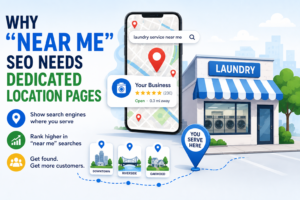
work that way. To compete effectively in local search, businesses need dedicated location pages
designed specifically to support “near me” search intent.
Understanding How Google Interprets “Near Me” Searches
One of the biggest misconceptions about local SEO is that Google searches for the exact phrase
“near me” on a website. In reality, Google’s local algorithm uses a combination of signals to
determine which businesses are most relevant.
- User location
- Device GPS data
- Search intent
- Business proximity
- Website relevance
- Google Business Profile information
- Customer reviews
- Local authority signals
- Service area coverage
Google’s primary goal is to deliver the most relevant local business for the searcher’s needs. Therefore, businesses must provide clear geographic signals that help search engines understand where they operate and whom they serve.
Why Homepages Cannot Rank Everywhere
Many business owners assume that a homepage can rank throughout an entire metropolitan area.
However, Google evaluates each location independently.
For example, a laundry service located in Bell, California, may serve:
- Bell
- Huntington Park
- South Gate
- Maywood
- Commerce
- Cudahy
- Montebello
- Downey
While these cities are geographically close, Google treats each one as a separate local market.
A dedicated page targeting “Wash & Fold Service in Montebello” will generally have a stronger chance of ranking for Montebello searches than a homepage attempting to target every city at once.

The Evolution of Local SEO
Local SEO has evolved dramatically over the past decade. Previously, businesses could rank by building directory citations, acquiring backlinks, and repeating keywords.
Today’s local search algorithm focuses on three core factors:
1. Relevance
How closely does your content match what the searcher needs?
2. Proximity
How close is your business to the user’s location?
3. Prominence
How trusted and authoritative is your business online?
Dedicated location pages improve all three ranking factors simultaneously.
How Dedicated Location Pages Improve Search Relevance
Location pages provide Google with highly targeted geographic information that helps connect your services to specific communities. For example, a page optimized for:
Commercial Laundry Service in San Jose
clearly establishes a relationship between:
- The service being offered
- The city being served
- The target customer
This level of specificity significantly improves local relevance signals and increases the
likelihood of ranking for related searches.
The Hidden Connection Between “Near Me” Searches and Location Pages
Many business owners ask why location pages matter if customers are searching “near me” instead of city names.
The answer lies in how Google interprets geographic intent. When someone searches for
“laundry pickup near me,” Google looks for businesses that demonstrate strong relevance
within the searcher’s location.
By creating detailed pages for each city or neighborhood served, businesses provide Google with stronger evidence of their local presence and service coverage.
Why Generic Location Pages Fail
Some businesses attempt to scale local SEO by creating hundreds of nearly identical pages and simply swapping city names.
Google increasingly identifies this tactic as low-value content.
Common problems include:
- Duplicate content
- Poor user experience
- Weak rankings
- Low engagement
- Reduced site quality signals
Effective location pages must offer unique and useful information tailored to each market.
Essential Elements of a High-Performing Location Page
Unique Local Introduction
Introduce the city, neighborhood, or service area while discussing how your services benefit
local customers.
Service-Specific Content
- Service process
- Turnaround times
- Scheduling information
- Service benefits
- Coverage details
Local Customer Scenarios
Demonstrate how residents or businesses within the area use your services.
Frequently Asked Questions
- Do you offer same-day service?
- What ZIP codes do you serve?
- Is pickup and delivery available?
- How quickly can appointments be scheduled?
Trust Signals
- Customer testimonials
- Reviews
- Service guarantees
- Industry certifications
How Location Pages Support Google’s EEAT Framework
Google increasingly evaluates websites based on Experience, Expertise, Authoritativeness,
and Trustworthiness (EEAT).
Dedicated location pages support EEAT by demonstrating:
- Knowledge of local communities
- Industry expertise
- Customer success stories
- Reliable service coverage
- Trustworthy business information
The Rise of Hyperlocal SEO
Local SEO is becoming more precise. Businesses are increasingly targeting neighborhoods, ZIP codes, and micro-locations instead of broad city-level searches.
Examples include:
- Wash & Fold Service in Mission District
- Laundry Pickup Service in Noe Valley
- Commercial Laundry Service in Downtown San Jose
- Battery Replacement Service in Midtown Oklahoma City
Hyperlocal pages often face less competition while generating highly qualified leads.
Location Pages Improve Conversion Rates
SEO success isn’t just about rankings. It’s about generating customers.
Visitors are more likely to contact a business when they see content that specifically
addresses their area and local needs.
Benefits include:
- Higher call volume
- More quote requests
- Increased bookings
- Improved lead quality
- Higher conversion rates
The Importance of Internal Linking
Location pages should be integrated into your website’s overall structure.
Best practices include linking:
- Service Pages → Location Pages
- Location Pages → Related Services
- Blog Posts → Location Pages
- Industry Pages → Location Pages
Strong internal linking helps search engines understand page relationships and distribute
authority throughout the site.
Why Service-Area Businesses Benefit the Most
Service-area businesses often depend heavily on local SEO because customers never visit a physical storefront.
Examples include:
- Mobile mechanics
- Battery replacement companies
- HVAC contractors
- Plumbing services
- Laundry pickup and delivery providers
- Cleaning companies
- Pest control services
Dedicated location pages help these businesses establish clear geographic relevance and
improve local search visibility.
Common Local SEO Mistakes to Avoid
- Creating thin or duplicate location pages
- Targeting too many cities on one page
- Ignoring local customer intent
- Failing to include location-specific information
- Neglecting internal linking
- Missing conversion-focused elements
“Near me” searches represent some of the highest-intent traffic available online. Businesses that rely solely on generic service pages often struggle to compete in local search because they fail to provide the geographic relevance Google expects.
Dedicated location pages help search engines understand where you operate, strengthen local authority, improve rankings for both city-specific and near-me searches, and generate more leads from customers actively looking for your services.
Whether you operate a laundromat, battery replacement service, dental office, HVAC company, plumbing business, or any service-area company, location pages are one of the most valuable long-term assets you can build for sustainable local SEO growth.