

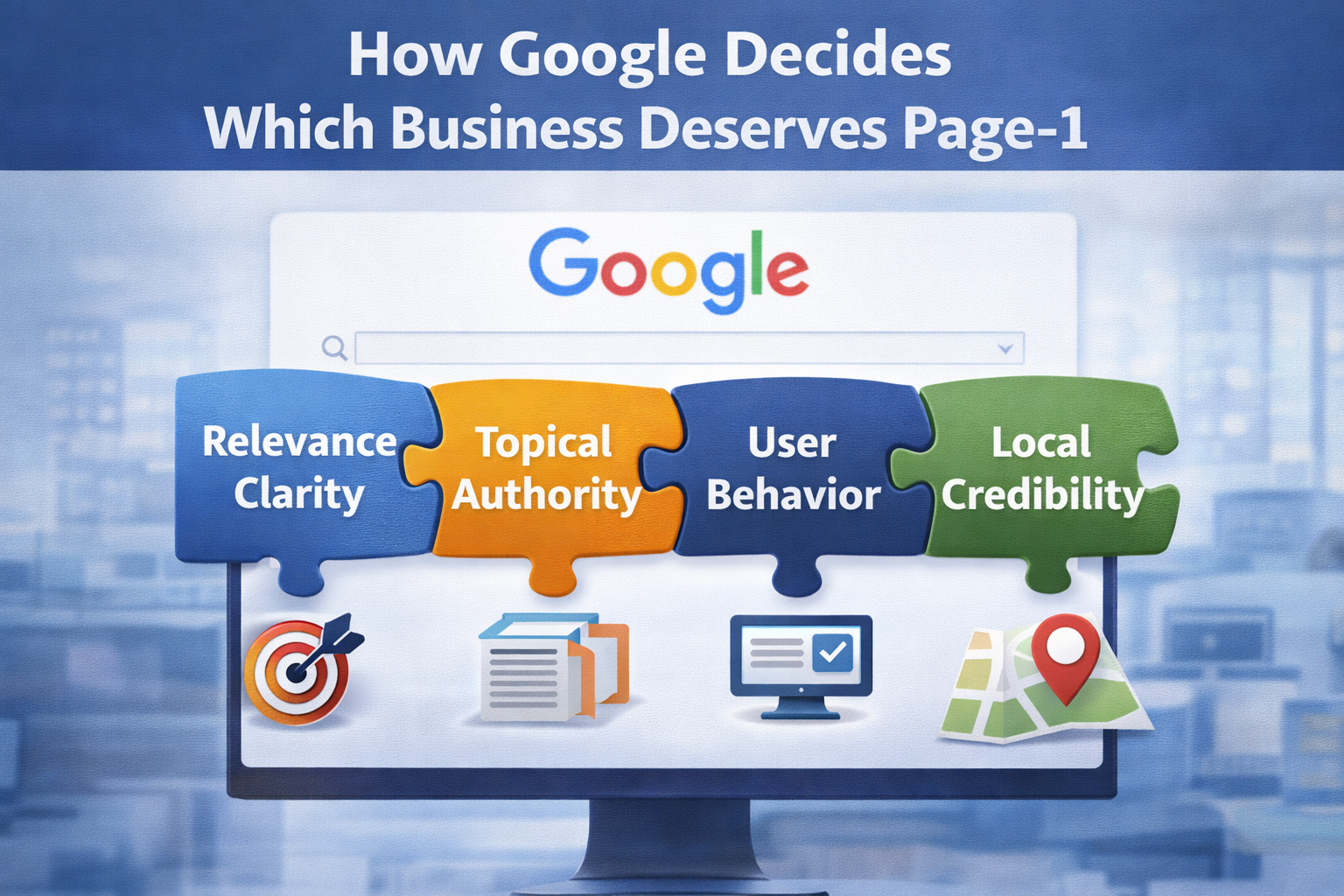
How Google Decides Which Business Deserves Page-1
A Strategic SEO Framework for Building Relevance, Authority, and Trust
In the modern digital economy, ranking on the first page of Google is not merely a marketing milestone — it is a decisive competitive advantage. Businesses that consistently appear in top search results gain disproportionate visibility, trust, and customer acquisition opportunities. Conversely, companies buried beyond the first page often struggle to generate predictable inbound demand, regardless of service quality.
Despite widespread awareness of SEO as a discipline, many business owners still misunderstand how Google actually determines ranking hierarchy. Some believe success depends primarily on technical hacks, backlink volume, or domain age. Others assume rankings are arbitrary or influenced by advertising budgets. In reality, Google’s evaluation process follows a sophisticated decision architecture designed to align search results with user satisfaction outcomes.
This strategic framework explains how Google decides which business deserves Page-1 visibility. By understanding and implementing these principles, organizations can transition from reactive optimization tactics to proactive authority building.
The Algorithmic Objective: Confidence in Recommendation
At its core, Google functions as a recommendation engine. Every search query represents a question, intent, or problem, and the search engine’s responsibility is to deliver the most reliable solution. Ranking decisions therefore revolve around algorithmic confidence — the degree to which Google believes a specific business can fulfill user expectations effectively.
Algorithmic confidence is not derived from a single metric. Instead, it emerges from the interaction of multiple signal clusters, including relevance clarity, topical authority depth, behavioral validation, trust architecture, and local credibility alignment. Understanding these clusters provides a blueprint for sustainable search visibility.
Framework 1: Relevance Clarity Model
The first and most influential ranking filter is relevance clarity. Before Google can recommend a business, it must clearly understand what that business does. Websites that communicate a precise service identity enable faster categorization, stronger semantic matching, and higher ranking confidence.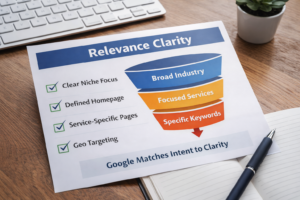
Consider two hypothetical companies. One promotes tire replacement, battery services, real estate consulting, and digital marketing from a single homepage. Another focuses exclusively on automotive maintenance solutions within a defined geographic service area. From an algorithmic perspective, the second company presents a clearer contextual identity. Reduced ambiguity leads to stronger relevance scoring for related searches.
Structural elements that strengthen relevance clarity include a primary value proposition statement, clearly segmented service descriptions, geographic references aligned with search intent, and logical internal linking pathways directing users to deeper content resources. These components act as semantic anchors that guide both search engines and visitors.
Framework 2: Topical Authority Ecosystem
Modern SEO performance depends less on isolated keyword targeting and more on demonstrating comprehensive subject expertise. Topical authority emerges when a business systematically covers its service landscape through interconnected content assets.
A service provider building authority might develop pillar pages explaining core offerings, educational blog articles addressing common customer questions, seasonal maintenance guides reflecting contextual demand cycles, and localized landing pages targeting hyper-specific geographic queries. Each content asset reinforces thematic credibility and strengthens domain-level trust signals.
Authority is cumulative. Search engines reward sustained expertise demonstration rather than sporadic optimization bursts. Businesses that consistently expand their knowledge ecosystem create a durable competitive moat in search visibility.
Framework 3: Behavioral Validation Signals
Google’s ranking systems increasingly incorporate user interaction patterns to validate content effectiveness. While exact algorithmic formulas remain confidential, observable trends indicate that engagement quality influences ranking stability.
Behavioral validation includes metrics such as session duration, scroll depth, repeat visits, navigation pathways, and interaction with conversion elements. These signals help search engines assess whether users find genuine value in the recommended result.
From a strategic perspective, this means SEO cannot exist in isolation from user experience design. Fast loading speeds, mobile responsiveness, intuitive navigation structures, and visually digestible content formatting contribute directly to engagement performance. Over time, positive interaction patterns reinforce ranking resilience.
Framework 4: Trust Architecture Engineering
Beyond relevance and engagement, search engines evaluate structural credibility indicators. Trust architecture involves embedding authenticity signals across the entire website ecosystem.
Effective trust signals include verified customer testimonials, transparent explanations of services or pricing models, real operational imagery, professional team representation, and clearly accessible contact channels. These elements influence both human perception and algorithmic interpretation.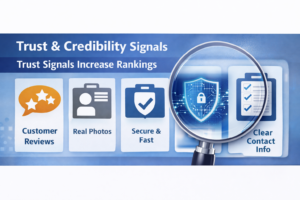
Trust also depends on consistency. Websites that maintain stable thematic positioning, update content regularly, and demonstrate operational continuity signal long-term reliability. Sudden service diversification or inconsistent messaging can dilute perceived authority.
Framework 5: Local Credibility Alignment
For service-based businesses, local SEO introduces an additional dimension of ranking evaluation. Geographic relevance, proximity signals, review sentiment trends, and citation consistency all contribute to local visibility performance.
Strategically developed local landing pages referencing neighborhoods, service zones, and community engagement initiatives strengthen contextual alignment with location-based queries. Authentic customer reviews further amplify credibility by functioning as behavioral trust proxies. Positive sentiment patterns improve click-through likelihood and reinforce perceived reliability.
Framework 6: Structural SEO and Conversion Synergy
Achieving first-page rankings is only valuable when visibility translates into meaningful customer actions. Search engines increasingly favor websites that facilitate seamless decision journeys from discovery to inquiry.
Structural alignment involves logical navigation flows guiding visitors toward priority service pages, clearly visible calls-to-action encouraging engagement, mobile-first layouts ensuring accessibility across devices, and technical performance optimization minimizing friction.
When website architecture simultaneously supports indexing efficiency and conversion clarity, ranking sustainability improves significantly.
Authority Consistency as a Long-Term Advantage
Page-1 visibility rarely results from isolated optimization tactics. Instead, it reflects cumulative authority consistency built through disciplined strategic execution. Businesses that publish educational resources, refine messaging frameworks, monitor performance analytics, and adapt to evolving algorithmic expectations gradually strengthen algorithmic confidence.
This long-term resilience enables them to maintain rankings even during major search engine updates that target superficial or manipulative tactics.
Strategic Implementation Roadmap
Organizations seeking sustainable first-page performance can follow a phased execution model. The first phase focuses on identity definition, clarifying niche positioning and restructuring homepage communication accordingly. The second phase builds authority architecture through pillar content and supporting topical clusters. The third phase prioritizes experience optimization, improving technical performance and navigation clarity.
The fourth phase amplifies trust by integrating credibility signals such as testimonials and operational transparency. The final phase reinforces local alignment through location-specific content development and consistent citation management.
Conclusion: Page-1 as an Outcome of Strategic Clarity
Ultimately, Google’s ranking decisions reflect its mission to recommend reliable, high-value solutions to users. Businesses that align relevance clarity, topical authority depth, behavioral validation strength, trust architecture maturity, and local credibility signals create a cohesive digital presence worthy of prominent visibility.
Rather than pursuing shortcuts or temporary ranking tactics, forward-thinking organizations invest in structured authority development. By doing so, they transform their websites into scalable growth engines capable of sustaining long-term market leadership.
Page-1 is not achieved by chance. It is earned through deliberate strategic clarity, consistent execution discipline, and a deep understanding of how search ecosystems interpret real business value.