

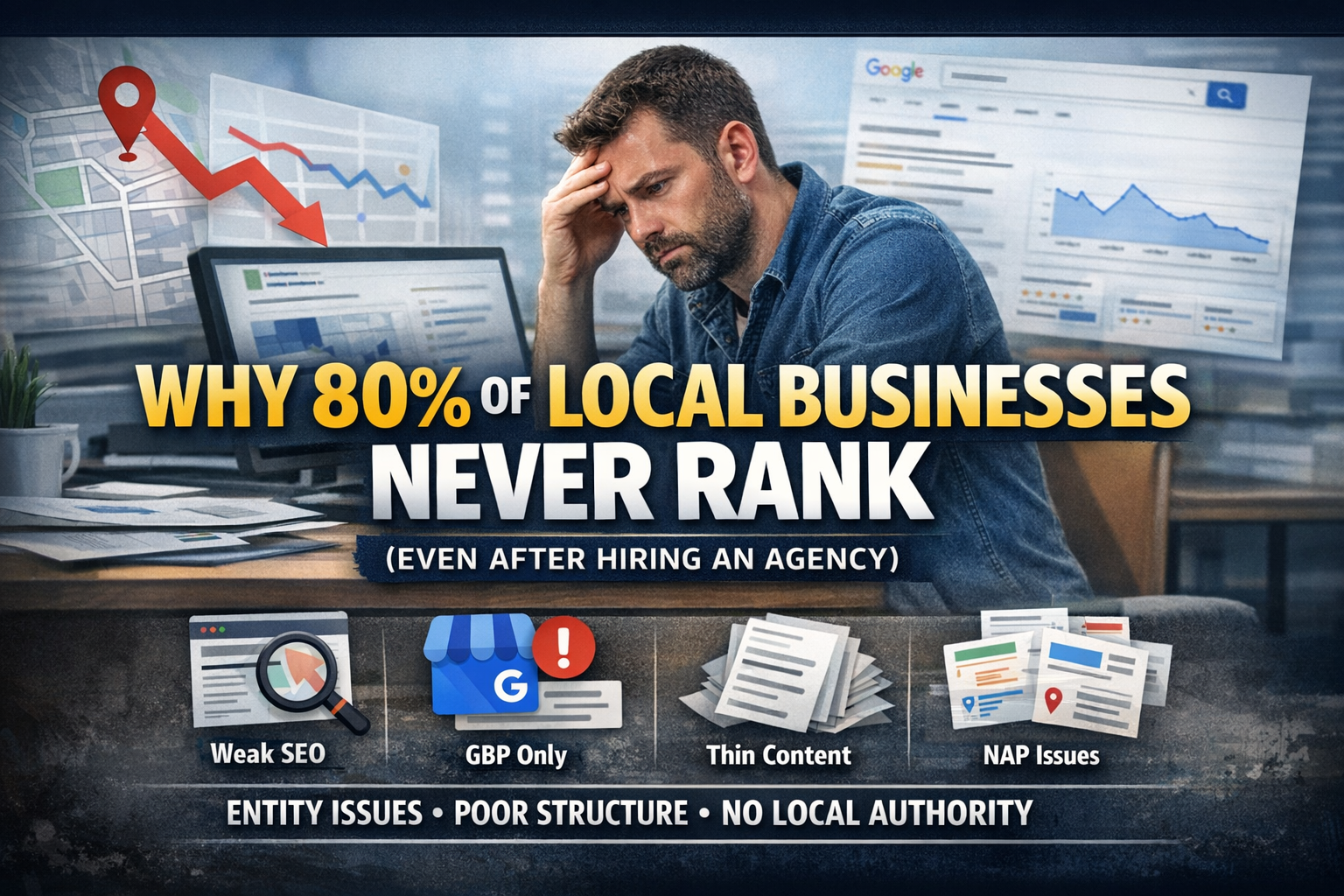
Why 80% of Local Businesses Never Rank (Even After Hiring an Agency)
Introduction: This Isn’t About Google Being Unfair
Every year, thousands of local businesses invest in SEO services expecting growth in visibility, phone calls, and revenue. Yet the reality is stark: the majority never break into dominant local positions. This failure is rarely due to effort or budget alone. It stems from a fundamental misunderstanding of how local ranking systems operate.
Local SEO is not simply about adding keywords to pages or collecting reviews. It is a layered ecosystem that evaluates entity clarity, geographic precision, authority reinforcement, and behavioral validation simultaneously. Most agencies optimize visible elements. Google ranks structural systems. Those are not the same thing.
After auditing hundreds of local service websites—plumbers, dentists, laundromats, contractors, clinics, and more—the pattern is consistent. The same structural weaknesses appear repeatedly. Below is a deep examination of the real reasons local businesses fail to rank even after paying for SEO services.
1. They Optimize Pages — Not Entities
Google does not rank pages in isolation in local search. It ranks entities connected to geographic relevance. An entity is a complete representation of your business across multiple systems, including your website, Google Business Profile, citations, reviews, categories, structured data, and user interaction signals.
Many agencies focus on surface-level optimization such as title tags, meta descriptions, header tags, and keyword placement. While these elements matter, they are not foundational. Google’s local system evaluates entity consistency, prominence, trust, and clarity across the web.
If Google cannot clearly understand who you are, what you do, where you operate, and why you are authoritative compared to competitors, ranking becomes unstable or impossible. Keyword stuffing does not build entity clarity. Structured consistency does.
2. No Clear Service–Location Architecture
Most local websites have a weak structural layout: a homepage, a generic services page, a contact page, and perhaps a blog. From a ranking systems perspective, this architecture lacks precision.
Google maps search intent to specific URL intent. When someone searches for “emergency plumber in Noe Valley,” the algorithm looks for a page that directly reflects both the service and the geography. If your site only has a broad “Plumbing Services” page, you lack geographic precision.
A strong architecture separates service hubs from location-specific variations and connects them through intentional internal linking. Precision reduces ambiguity. Ambiguity reduces ranking strength.
3. Over-Reliance on Google Business Profile
Many agencies adopt a Google Business Profile–only strategy, focusing on reviews, photos, categories, and posts. While GBP is powerful, it does not exist independently of website authority.
Google’s own documentation makes it clear that prominence derives from web results, backlinks, articles, and broader authority signals. Your GBP is reinforced—or weakened—by your website’s topical depth and backlink relevance.
The Map Pack and organic rankings are interconnected systems. Weak organic authority often limits map visibility. Businesses that ignore website authority cap their own growth.
4. Thin Location Pages and Template Swapping
One of the most common structural mistakes is mass-producing city pages by copying content and swapping location names. Google’s quality systems are sophisticated enough to detect templates geo content.
If 80% of your location pages are identical, they lack unique geographic signals and depth. Strong location pages include neighborhood references, locally relevant FAQs, contextual examples, landmarks, and structured internal linking.
If your page could rank in any city by replacing the name, it likely will not rank in any city at all.
5. No Topical Authority Depth
Local SEO is not separate from topical authority. It amplifies it. If a dental clinic wants to rank for cosmetic dentistry but only has one generic page, it competes poorly against clinics with comprehensive coverage: veneers, whitening, smile design, consultation guides, FAQs, and case galleries.
Google evaluates topic depth, semantic coverage, and content relationships. Authority plus proximity creates dominance. Without depth, rankings rely solely on proximity, which is unstable in competitive markets.
6. Weak Internal Linking Architecture
Internal linking is not navigation—it is authority flow. Google interprets contextual anchor text and page hierarchy to understand topic relationships.

If service pages do not link to related location pages, if location pages do not reinforce parent services, and if blogs do not support commercial intent, authority becomes fragmented. A structured silo consolidates ranking power and strengthens semantic clarity.
7. Backlinks Without Relevance
Not all backlinks are equal in local SEO. Agencies often build directory links or guest posts on irrelevant blogs. Google’s local prominence relies heavily on contextual and geographic relevance.
A plumbing company benefits more from local news mentions and chamber of commerce listings than from random international blog links. Quantity does not outweigh contextual alignment.
8. Ignoring Behavioral Signals
Google monitors aggregate engagement signals such as click-through rate, dwell time, direction requests, call clicks, and return-to-search behavior.
If users consistently engage more deeply with competitor listings, rankings adjust accordingly. Poor design, slow load times, weak messaging, and thin content reduce engagement. Reduced engagement weakens prominence over time.
9. Category Misalignment
Primary category selection in Google Business Profile significantly affects query matching. Choosing overly broad or incorrect categories suppresses visibility.
Precise category alignment strengthens relevance signals. Many businesses underestimate how heavily weighted this factor is in local ranking systems.
10. Inconsistent NAP and Citation Signals
Citations are not dead. They are foundational trust validators. Google cross-references business name, address, phone, and website across directories and data aggregators.
Inconsistent data weakens entity clarity. While citations alone do not boost rankings dramatically, they stabilize trust. Without that stability, prominence suffers.
11. Lack of Structured Data
Structured data such as LocalBusiness schema, Service schema, and FAQ schema reinforces entity identity, geographic scope, and service offerings.
Structured data is not a shortcut—it enhances clarity. Clarity builds confidence. Confidence improves ranking stability.
12. Poor Content Quality (E-E-A-T Failure)
Google evaluates Experience, Expertise, Authoritativeness, and Trust. Many local service pages rely on generic AI-style content without proof, depth, or specificity.
Strong content includes real images, team profiles, credentials, detailed service explanations, and transparent policies. Thin content weakens trust classifiers and reduces long-term ranking durability.
13. Expecting Immediate Results
Local SEO compounds over time. Google evaluates data accumulation, link velocity, behavioral consistency, and entity aging.
Businesses that change agencies frequently disrupt momentum. Authority builds gradually. Instability delays growth.
14. Competing in Saturated Markets Without Differentiation
In dense markets, proximity alone is insufficient. Authority, engagement, and differentiation determine winners.
If fifteen competitors operate within a few miles, Google favors those with stronger engagement, deeper authority, and clearer relevance—not simply the business with the most pages.
15. Template-Based SEO Strategies
Local SEO is not plug-and-play. Each niche requires customized keyword mapping, category research, competitive analysis, and structural architecture.
Agencies that apply identical templates across industries produce predictable, mediocre results.
Final Professional Takeaway
Most local businesses fail because they optimize isolated elements while Google evaluates integrated systems.
A true local ranking system includes entity clarity, geographic precision, topical depth, internal architecture, behavioral reinforcement, authority stacking, and trust validation.
Miss even two layers and rankings weaken. Miss several and visibility disappears.
Local SEO today is not about adding keywords or building random links. It is about building a structured, entity-driven, relevance-aligned authority ecosystem.
Agencies that treat local SEO like it is 2015 fail. Businesses that understand structure and system alignment win.