


And What It Uses to Rank You
This is not a beginner’s overview. This is a structural, technical, and strategic breakdown of how modern search engines interpret your site.
1. Crawling: The Discovery Layer
Before Google ranks anything, it must discover it.
Googlebot discovers URLs through:
- Internal links
- External backlinks
- XML sitemaps
- Previously indexed pages
- Redirect chains
- RSS feeds
- Manual URL submission
Crawl Budget and Efficiency
On small sites, crawl budget rarely becomes a constraint. On large sites — especially ecommerce, publishing, SaaS, and marketplace platforms — crawl allocation becomes critical.
Crawl inefficiencies include:
- Faceted navigation generating infinite URLs
- Parameter duplication
- Orphan pages
- Soft 404s
- Broken internal linking
- Slow server response times
If Googlebot spends its resources crawling low-value URLs, high-priority pages may not be revisited frequently. Crawl management is foundational technical SEO.
Google reads your internal linking architecture as a signal of importance. Pages buried deep in navigation with weak internal signals are treated as lower priority.
Discovery influences ranking indirectly by influencing freshness and indexation reliability.
2. Rendering: HTML First, JavaScript Later
Google uses a two-stage indexing pipeline:
- Initial crawl and HTML parsing
- JavaScript rendering via Web Rendering Service (WRS)
During the first pass, Google extracts:
- Title tag

- Meta robots
- Canonical tags
- Headings
- Structured data
- Internal links
- Core text content
If primary content is loaded only after JavaScript execution, indexing may be delayed. While Google can render JavaScript, it is resource-intensive and deferred.
Best practice:
- Ensure primary content exists in server-rendered HTML
- Avoid JS-dependent navigation structures
- Validate using URL Inspection in Google Search Console
If Google cannot reliably access your DOM content, it cannot rank it confidently.
3. Indexing: Eligibility, Not Guarantee
Crawling does not guarantee indexing.
Google evaluates inclusion based on:
- Duplicate detection
- Thin content evaluation
- Canonical consolidation
- Internal linking signals
- Overall site quality
- Soft 404 detection
- Spam patterns
Indexation is a quality filter. Google compares your page to others in the ecosystem before deciding eligibility.
4. What Google Actually Reads (Core On-Page Signals)
4.1 Title Tag
The title tag remains one of the strongest on-page ranking signals. Google evaluates query alignment, topical relevance, brand association, over-optimization, and rewrite necessity.
- Align title with search intent
- Avoid keyword stuffing
- Ensure contextual completeness
- Reflect page purpose accurately
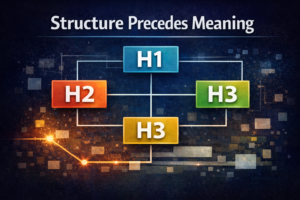
4.2 Headings and Structural Hierarchy
Headings create semantic segmentation and topic clarity.
- One clear H1
- H2s defining core sections
- H3/H4s supporting depth
Structure precedes semantic interpretation.
4.3 Body Content and Semantic Depth
Google extracts entities, co-occurrence patterns, semantic relationships, contextual completeness, and topic coverage depth.
It evaluates whether your page:
- Fully answers the query
- Demonstrates expertise
- Covers supporting subtopics
- Outperforms competing indexed pages
Google reads topical authority — not keyword density.
4.4 Internal Linking
Internal links influence:
- Discovery
- Authority distribution
- Contextual reinforcement
A strategic internal linking system builds topic clusters and strengthens pillar pages.
4.5 Structured Data
Structured data clarifies entities and enhances rich result eligibility. It improves interpretation and SERP visibility but does not directly boost rankings.
4.6 Media and Image Signals
Google reads:
- Alt text
- File names
- Surrounding content
- Structured markup
Google relies on textual context to interpret images.
5. Off-Page Signals Google Reads
Google evaluates external patterns including: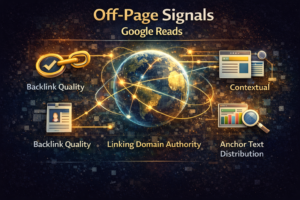
- Backlink quality
- Linking domain authority
- Topical relevance
- Anchor distribution
- Brand mentions
- Citation consistency
Authority is relational, not numerical.
6. E-E-A-T Signals and Trust Inference
 Google evaluates:
- Author transparency
- External validation
- Brand presence
- Reputation signals
- Content depth
Authority is inferred from patterns across the web.
7. Behavioral and Engagement Reinforcement
Google may interpret large-scale behavioral patterns such as query reformulations and SERP engagement trends to refine ranking systems over time.
8. Technical Performance Signals
- Core Web Vitals
- Mobile usability
- HTTPS security
- Page speed
- Intrusive interstitial compliance
Performance amplifies quality — it does not replace it.
9. Ranking Is Comparative, Not Absolute
Google compares your page against competing pages for a query based on relevance, authority, structure, and likelihood of satisfying user intent.
10. What Google Does NOT Read or Reward
- Aesthetic design
- Animation complexity
- Color schemes
- Expensive frameworks
- Visual modernity
Clarity, depth, and contextual signals win.
Strategic Takeaway
Google reads:
- Crawlable HTML
- Structured headings
- Semantic depth
- Entity relationships
- Internal linking architecture
- Authority networks
- Performance signals
- Competitive landscape context
If your site is structurally clear, technically accessible, semantically comprehensive, and contextually authoritative, Google can interpret it confidently — and interpretation precedes ranking.
Frequently Asked Questions
1. How does Google crawler see my website?
Googlebot reads the HTML source code first, extracting titles, headings, links, structured data, and core text before rendering JavaScript.
2. How does Google find new pages?
Through internal links, backlinks, XML sitemaps, redirects, and previously indexed URLs.
3. Why is my page crawled but not indexed?
Common causes include thin content, duplication, canonical issues, or insufficient comparative value.
4. Does Google read JavaScript content?
Yes, but during a deferred rendering stage. Critical content should exist in server-rendered HTML.
5. Are keywords still important?
Yes, but contextual authority and semantic coverage matter more than exact-match repetition.
6. Does structured data improve rankings?
It improves clarity and rich result eligibility but does not directly increase rankings.
7. How important are internal links?
They are critical for discovery, authority distribution, and contextual clarity.
8. Does website design affect SEO?
Design influences UX, but rankings are driven by structure, clarity, and authority.
9. How does Google measure authority?
Through backlink quality, brand mentions, and ecosystem-wide relevance patterns.
10. What is the most important ranking factor?
There is no single factor. Rankings emerge from relevance, authority, structure, depth, and competitive positioning.
Final Conclusion
Google does not rank pages because they look impressive. It ranks pages because they are interpretable, relevant, authoritative, structurally sound, and competitively superior.
Professional SEO is not about gaming algorithms. It is about engineering clarity at scale — better than anyone else in your niche.
That is what Google actually reads.