


Why Google Maps SEO Has Fundamentally Changed
Google Maps is no longer powered by simple keyword matching, proximity signals,
or surface-level optimization tactics. Over the past few years, Google has quietly
transformed Maps into an AI-driven entity understanding and validation system.
This shift has fundamentally broken many traditional local SEO strategies. Businesses
that once ranked consistently now disappear without any clear explanation, while others
with fewer reviews or weaker backlinks suddenly dominate results.
The reason is not keywords.
The reason is interpretability.
Google Maps no longer asks:
“Which businesses match this keyword?”
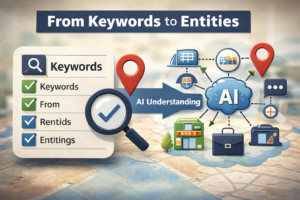 Instead, it asks:
“Which businesses can I confidently understand, validate, and trust for this intent?”
If your business fails that test, it is not downgraded or pushed lower.
It is filtered out before ranking even begins.
This guide explains exactly how that process works—and how to optimize for it.
1. From Keywords to Entity Understanding
The Old Model (Pre-AI Maps)
Historically, Google Maps relied on a reactive ranking model based on:
- Business categories
- Keyword usage in the business name
- Reviews and proximity
- Basic website relevance
A search query triggered a results list, and businesses competed primarily on
keyword presence and distance.
The New Model (AI-Driven Maps)
Today, Google Maps works proactively. Before any results are shown, Google’s
systems attempt to:
- Understand what each business actually does
- Validate service claims across multiple sources
- Determine eligibility for a specific search intent
This is entity-first evaluation. Your business is no longer treated
as a keyword match, but as a data object with attributes that must be clearly defined.
2. The Pre-Validation Layer (The Part Most People Miss)
Before traditional ranking logic is applied, every business passes through a
pre-validation phase.
During this phase, Google evaluates:
- Business identity
- Service clarity
- Data consistency
- Trustworthiness
If clarity or confidence is insufficient, the business is excluded silently.
 Key Insight:
Most perceived “ranking drops” are not ranking issues at all.
They are pre-validation failures.
3. How Google Maps AI Interprets Search Intent
Google Maps queries are no longer interpreted literally. When a user searches,
Google’s AI:
- Infers the primary intent
- Expands that intent into semantic variations
- Tests those variations against business entities
Example:
A search for “emergency plumber near me” expands into:
- Urgent plumbing service
- Same-day plumbing repair
- Water leak repair
- Residential plumbing availability
Your business must clearly and consistently support these interpretations.
4. Why a Google Business Profile Alone Is Not Enough
A Google Business Profile (GBP) is a claim, not proof.
Google cross-checks GBP data against multiple confirmation sources, including:
- Website content
- Service pages
- Headings and summaries
- Images
- External citations
- User-generated content


If your GBP claims a service that your website fails to confirm clearly,
Google’s confidence drops—and so does your eligibility.
5. The Website’s Role in Maps Visibility
Your website is no longer just “supporting SEO.”
It is a primary validation source.
Google analyzes websites for:
- Topic decomposition
- Structural clarity
- Speed of confirmation
- Extractable answers
What this means:
A well-structured 800-word page can outperform a 4,000-word page with poor organization.
6. Micro-Topics: How Google Breaks Down Content
Google does not read pages linearly. Instead, it breaks them into:
- Sections
- Headings
- Subheadings
- Summary blocks
- Lists
Each block is evaluated independently. If a section cannot clearly answer:
“What service is this business providing?”
That section is ignored.
7. Why Heading Structure Is Now a Ranking Gatekeeper
Headings are no longer stylistic elements. They now function as:
- Semantic anchors
- Validation checkpoints
- Answer containers
Effective Headings
- Emergency Plumbing Services in Austin
- 24/7 Water Leak Repair for Homes
Ineffective Headings
- What We Can Do For You
- Solutions That Matter
- Why Clients Love Us
If a heading cannot stand alone as an answer, it fails.
8. The Rise of TL;DR and Summary Blocks
Google prioritizes speed of understanding.
Summary blocks allow Google to:
 Confirm relevance instantly
- Decide whether deeper processing is necessary
- Extract answers for AI-driven systems
 Confirm relevance instantly
Best Practice:
Every key service page should begin with:
- A 2–4 sentence summary
- A clear service definition
- Explicit service + location alignment
No summary equals delayed understanding—and delayed understanding lowers confidence.
- Understand you quickly
- Validate you confidently
- Trust you consistently
You get shown. If not, you disappear—without warning.